China’s modular housing sector is gaining attention as developers seek faster, lower-waste construction options. Container-Shippable Modular Homes combine factory production with international container logistics. Their steel frames, insulated wall panels, plumbing lines, and electrical systems can arrive as compact units. The concept sounds simple. The details are not.
UNCTAD’s Review of Maritime Transport 2024 reported that global seaborne trade reached approximately 12.3 billion tonnes in 2023. Container shipping remains central to international supply chains, but freight rates, port congestion, and route disruptions can change project economics quickly. The World Shipping Council also identifies the 40-foot container as a major standard in global transport. This helps explain why transportable modular designs often prioritize width, folded components, and assembly efficiency.
Industry evidence supports cautious optimism. McKinsey estimated that modular construction could represent more than $100 billion in annual value across major European and North American markets by 2030. However, that forecast does not guarantee quality or profitability for every supplier. Manufacturing precision, welding standards, insulation performance, fire protection, and documentation require direct verification. Some published factory claims remain difficult to compare.
This guide examines China’s top 10 manufacturers of Container-Shippable Modular Homes. The selection considers export experience, production capacity, customization, certifications, delivery records, and after-sales support. Product photos alone are insufficient. A reliable supplier should provide drawings, material specifications, test documents, container-loading plans, and transparent warranty terms. Buyers should also confirm local building-code compatibility before signing contracts. The ranking is not absolute. It is a practical starting point for deeper due diligence.
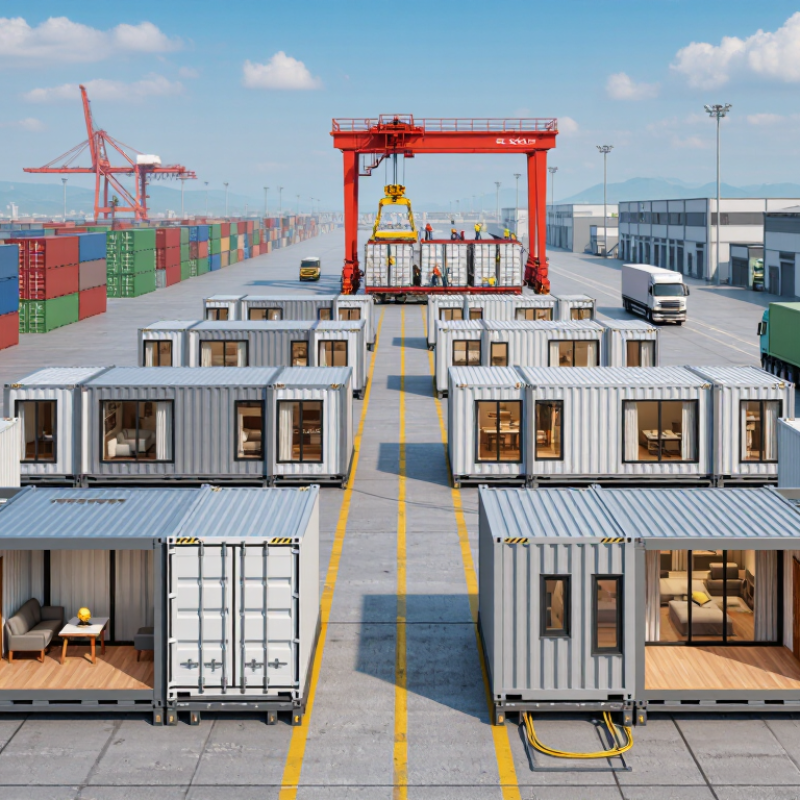
ISO 668:2020 sets the basic dimensions for Series 1 freight containers. A standard 20-foot container measures about 6.06 metres long and 2.44 metres wide externally. A 40-foot unit extends to approximately 12.19 metres. High-cube models add nearly 30 centimetres in height. Internal width usually remains close to 2.35 metres, creating a narrow living envelope. Those few centimetres matter. Insulation, wiring, wall panels, and ventilation quickly reduce usable space. ISO 1496-1 also covers structural performance and testing requirements.
China’s modular-home manufacturing landscape benefits from a mature container supply chain. UNCTAD’s Review of Maritime Transport 2024 identifies China as the leading container port-handling economy, with roughly 296 million TEU handled in 2023. This industrial depth supports faster steel processing, standardized components, and export logistics. Yet container availability does not guarantee housing quality. A shell can look precise while thermal bridges, roof drainage, or weak welds remain hidden. Factory audits should review material certificates, weld inspection records, moisture control, and completed installation photographs. The least attractive detail may become the costliest repair.
Tips: Ask for drawings showing finished internal dimensions, not only external container sizes. Check door clearances after insulation. Request a prototype inspection before approving volume production. A practical review may reveal that a cheaper layout feels cramped, especially around kitchens and bathrooms.
| Rank | Anonymous Manufacturer Profile | Typical Modular Product | Primary ISO Container Basis | Nominal External Size | Approx. Gross Floor Area | Common Structural Material | Typical Compliance Documentation | Best-Fit Application |
|---|---|---|---|---|---|---|---|---|
| 1 | Profile 01 – High-volume container-home producer | Finished single-module dwelling | 40-ft High Cube | 12.192 × 2.438 × 2.896 m | About 29.7 m² | Weathering steel container frame with insulated wall panels | Welding inspection, material certificates, electrical test records, packing list | Export housing, worker accommodation, temporary offices |
| 2 | Profile 02 – Foldable modular-unit producer | Foldable flat-pack accommodation unit | 20-ft container envelope | 6.058 × 2.438 × 2.591 m | About 14.8 m² | Light-gauge steel frame with sandwich panels | Assembly instructions, structural drawings, fire-performance data where required | Rapid-deployment camps and site facilities |
| 3 | Profile 03 – Expandable-home producer | Expandable container-style home | 20-ft or 40-ft base module | 6.058 or 12.192 m long | Approximately 15–37 m² after expansion | Galvanized steel frame, insulated composite panels | Load calculations, hinge and locking-system checks, electrical documentation | Small homes, classrooms and emergency accommodation |
| 4 | Profile 04 – Premium architectural module producer | Architect-designed container residence | 40-ft High Cube | 12.192 × 2.438 × 2.896 m | About 29.7 m² before extensions | Reinforced steel frame, mineral wool or PIR insulation | Shop drawings, thermal calculations, glazing and finish schedules | Holiday cabins, guest suites and remote residences |
| 5 | Profile 05 – Flat-pack modular building producer | Panelized modular house kit | Container-compatible packing modules | Packed to 20-ft or 40-ft load limits | Project-dependent; commonly 18–60 m² | Cold-formed steel, fiber-cement boards and insulation cores | Component schedules, installation manuals and packing plans | Self-build projects and multi-unit developments |
| 6 | Profile 06 – Prefabricated steel-villa producer | Steel-frame modular villa | Multiple container-width modules | Each module commonly 2.438 m wide | About 60–150 m² per project | Cold-formed or welded galvanized steel frame | Structural calculations, corrosion protection records and installation drawings | Permanent residential construction |
| 7 | Profile 07 – Construction-site accommodation producer | Dormitory, office and sanitary modules | 20-ft standard or High Cube | 6.058 × 2.438 m footprint | About 14.8 m² per module | Steel chassis, insulated panels and prefitted services | Electrical, plumbing, lifting and site-connection documentation | Mining, infrastructure and construction projects |
| 8 | Profile 08 – Sustainable modular-home producer | Energy-efficient container-based home | 40-ft High Cube or combined modules | 12.192 × 2.438 × 2.896 m | About 29.7 m² per module | Recycled-content steel, high-performance insulation and low-energy equipment | Thermal-performance data, material declarations and energy-system specifications | Low-energy housing and eco-resorts |
| 9 | Profile 09 – Sanitary and utility module producer | Bathroom, kitchen and utility pods | 20-ft or 40-ft module | 2.438 m standard external width | About 5–30 m² per pod | Steel frame, cement board, waterproof finishes and prefitted plumbing | Pressure tests, drainage tests, waterproofing records and wiring checks | Hotels, camps, schools and residential projects |
| 10 | Profile 10 – Emergency and humanitarian housing producer | Rapid-deployment shelter and clinic module | 20-ft or 40-ft shipping-compatible unit | 6.058 or 12.192 m long | About 14.8–29.7 m² per unit | Light steel frame, insulated panels and durable flooring | Packing list, lifting points, assembly guide and basic safety documentation | Disaster relief, medical facilities and temporary settlements |
Price should not lead the ranking. Review production history, export records, capacity, and completed projects. A glossy catalog can mislead. Lower scores fit incomplete evidence.
Request inspection reports, material certificates, client references, and factory ownership details. Photographs help, but they prove less than independent records. Ask for recent evidence. Old references may not reflect current quality.
Request structural drawings, wind-load calculations, snow-load data, fire-safety information, and insulation values. Check whether the modules fit shipping limits without excessive dismantling. Small details matter.
Inspect steel thickness, panel joints, roof drainage, wiring, plumbing, and corrosion protection. Look closely at welds and sealant. A tiny gap can admit water after delivery.
A 20-foot unit usually needs fewer handling steps but provides less usable space. A 40-foot unit offers better space efficiency, though handling may cost more. The site decides. Measure access roads, turning areas, and crane positions before choosing.
Indicative ocean freight may range from 1,500 to 6,000 USD for a 20-foot container. A 40-foot container may cost 2,500 to 10,000 USD. Routes, seasons, and port congestion can change these figures quickly. Treat estimates as temporary.
A prepared foundation may allow crane placement in one day. Utility connections, weather sealing, and inspections commonly need another one to three weeks. Factory completion does not equal occupancy. That distinction is easy to miss.
Include freight, installation, customs documents, foundation work, packaging, spare parts, and local code adjustments. Compare insulation, windows, electrical systems, and fire performance too. One missing fitting can delay installation. A complete cost sheet is safer than a cheap quotation.
This guide examines China’s Container-Shippable Modular Homes industry, beginning with standard 20-foot and 40-foot ISO container dimensions and how they influence design, loading, transport, and on-site installation. It explains a practical method for evaluating manufacturers based on production capacity, customization capabilities, lead times, export experience, quality systems, and documented project performance rather than marketing claims alone.
The comparison also highlights essential compliance considerations, including CSC certification for international container transport, ISO 9001 quality management, CE requirements where applicable, and alignment with destination-country building codes. Readers will learn how to compare shipping costs for different container sizes, estimate installation schedules, and assess total value through durability, energy efficiency, maintenance needs, logistics, and after-sales support. The goal is to provide a clear framework for selecting reliable manufacturing partners and planning cost-effective modular housing projects for international delivery.